Economists Again a Minimum Wage Raise
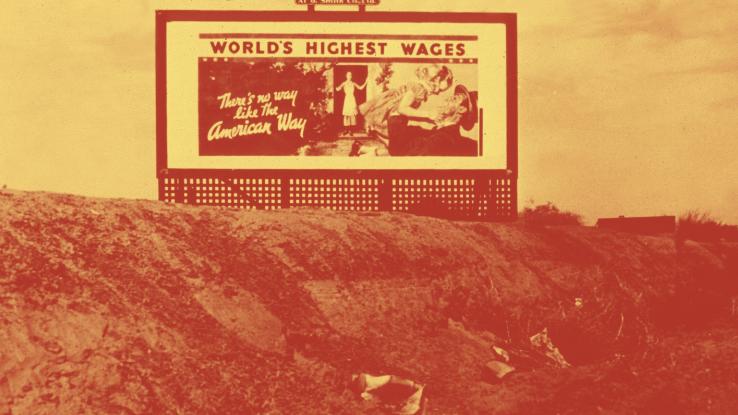
In 1938, Congress passed the Fair Labor Standards Human activity. This legislation affirmed that workers are entitled to a certain corporeality of compensation for their labor by instituting the kickoff federal minimum wage in the United States. But the conversation didn't stop in that location. In fact, since its introduction, the federal minimum wage has been raised 22 times. Even today, minimum wage — which isn't inherently adjusted to reverberate college costs of living — remains a hotly debated topic.
While the 1938 legislation marked an important first in U.S. history, laborers' push for a off-white minimum wage actually had its modern-day origins in France a century earlier. In 1831, silk industry workers in Lyon went on strike, demanding a livable minimum wage. Over lx years afterwards, New Zealand became the first nation to constitute a federal minimum wage with its 1894 Industrial Conciliation and Arbitration Act. In observance of National Poverty Sensation Calendar month, nosotros'll hash out the history of the federal minimum wage and its numerous changes.
The History of the Federal Minimum Wage in the United States
New Zealand's actions helped inspire minimum wage advocates in the United States. According to History, "Samuel Gompers, founding president of the American Federation of Labor, publishe[d] an article entitled 'A Minimum Living Wage,' in which he advocates not merely setting a legal threshold for wages, but as well requiring it to be plenty for workers to live." Needless to say, this article marked a turning point in the U.S.
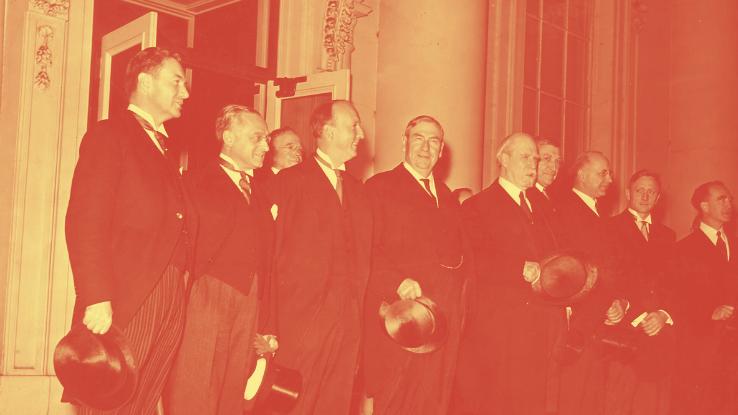
Finally, fourteen years after Gompers' article croaky the conversation broad open up, Massachusetts enacted the first minimum wage law in the U.S. By the post-obit year, eight other states, from California to Minnesota, followed arrange. However, a setback came in 1923 when the U.S. Supreme Court ruled that a state authorities could not gear up a minimum wage; co-ordinate to the Court, doing then would violate a precedent gear up forth in the Fifth Amendment.
Just a decade later, Americans establish themselves navigating the Swell Low. In an effort to assist workers and rebuild the economy, President Franklin D. Roosevelt rallied Congress to back up the National Industrial Recovery Human action (NIRA), which "suspends antitrust restrictions and allows industries to enforce their own fair-merchandise codes" (via History). Additionally, FDR encouraged employers to pledge to offering $12 to $15 weekly wages; in substitution, employers would be able to display "Nosotros Do Our Role" badges, reinforcing the sense of pride and patriotism the federal government was hoping to inspire in the confront of the Great Depression (and, later, World War II). In the terminate, these efforts encouraged various industries to enact minimum wage codes.
In 1935, the NIRA codes faced pushback from the Supreme Courtroom, which, in turn, made minimum wage the hot-push issue of the upcoming presidential election. Nevertheless, things took a existent turn in 1937 when Elsie Parrish, a maid at the Cascadian Hotel in Wenatchee, Washington, sued her former employer on the grounds that she was owed dorsum pay in accordance with Washington's weekly minimum wage law. Since the Court had previously ruled that "any form of police force establishing wages" was unconstitutional, the ruling on Westward Coast Hotel Co. five. Parrish came every bit a shock. Described by historians equally the "big switch," the Court ruled in favor of Parrish — and Washington'southward minimum wage laws.
This landmark ruling opened the door for Congress to pass the Off-white Labor Standards Act, which formally established a federal minimum wage. At the time, that minimum wage was 25 cents per 60 minutes; by 1949, Congress raised the minimum to 75 cents, marking the first of the 22 increases.
Today, the federal minimum wage applies to workers who are employed by businesses that make at to the lowest degree $500,000 in acquirement as well every bit folks who work in schools, hospitals, nursing homes, and government agencies. Additionally, workers who are involved in "interstate commerce" are also field of study to minimum wage protections (via U.South. Department of Labor).
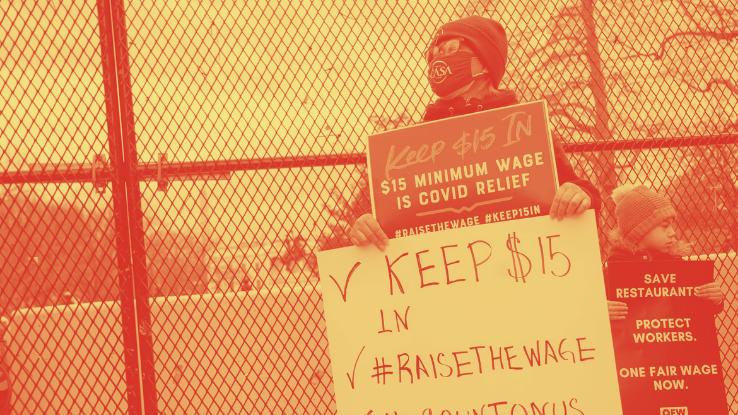
Although things have certainly changed over the years, many feel the fight for establishing a fair federal minimum wage is far from over. As mentioned above, much of this feeling comes from the fact that the minimum wage doesn't automatically adjust based on increased costs of living. As of January 2022, the federal minimum wage is still set at $seven.25 — and has been since 2009. Meanwhile, the cost of living in the U.S. continues to climb.
More than recently, attempts to account for these cost of living increases have been undertaken on a state-by-country basis. In 2016, both California and New York raised the minimum wage to $15 per hr (though it should be noted this increment to $fifteen is happening gradually). In full, 29 states (and Washington D.C.) have a higher minimum wage than the minimum set forth by the federal authorities, and, of those states, eight of them heighten those wages in accordance with increases in the cost of living.
Now, the COVID-nineteen pandemic has farther emphasized the fact that many workers do non make plenty money to afford basic necessities, like rent, food and healthcare-related expenses. So, what's being washed? On February 27, 2021, the U.Due south. House of Representatives passed the American Rescue Plan Act of 2021, a $1.ix trillion COVID-19 relief parcel that aims to extend unemployment benefits; provide help to minor businesses and nonprofits; cutting $1,400 relief checks to Americans; and, perhaps surprisingly, introduce a $xv federal minimum wage.
Reportedly, this increase, which would happen gradually until being fully realized in 2025, would have "boosted pay for some 32 meg workers" (via CNBC). We say "would have" considering in the offset few days of March, as the American Rescue Plan Deed moved to the Senate, the minimum wage provision was scrapped. Co-ordinate to Senate parliamentarian Elizabeth MacDonough, the provision did not comply with the rules of budget reconciliation.
While some Democrats have urged Vice President Kamala Harris to overrule MacDonough, information technology doesn't seem similar the White Business firm will do then, despite previously supporting a minimum wage increment. For now, it seems similar a federal minimum wage increment is off the table, but it's articulate that lawmakers — and everyday Americans — won't stop fighting for information technology. Moreover, many states are raising their minimum wage rates irrespective of federal policies.
Source: https://www.reference.com/business-finance/federal-minimum-wage-3fcaa76aed287408?utm_content=params%3Ao%3D740005%26ad%3DdirN%26qo%3DserpIndex

Post a Comment for "Economists Again a Minimum Wage Raise"