Continue to Break Point Again Visual Studio
This browser is no longer supported.
Upgrade to Microsoft Edge to take reward of the latest features, security updates, and technical support.
Navigate through code by using the Visual Studio debugger
The Visual Studio debugger can help you navigate through code to inspect the state of an app and show its execution flow. You can use keyboard shortcuts, debug commands, breakpoints, and other features to quickly get to the code you lot want to examine. If you're familiar with debugger navigation commands and shortcuts, y'all can observe and resolve app problems faster and more than hands.
Enter interruption mode
In break manner, app execution is suspended while functions, variables, and objects remain in memory. When the debugger is in break mode, you can navigate through your code. There are 2 common ways to quickly enter break mode:
-
Begin code stepping by selecting F10 or F11. Doing so allows you to chop-chop find the entry point of your app. You can then continue to printing step commands to navigate through the code.
-
Run to a specific location or part, for example, by setting a breakpoint and starting your app.
For instance, in the code editor in Visual Studio, you tin can use the Run To Cursor control to showtime the app, debugger fastened, and enter break mode, and then select F11 to navigate through the lawmaking:
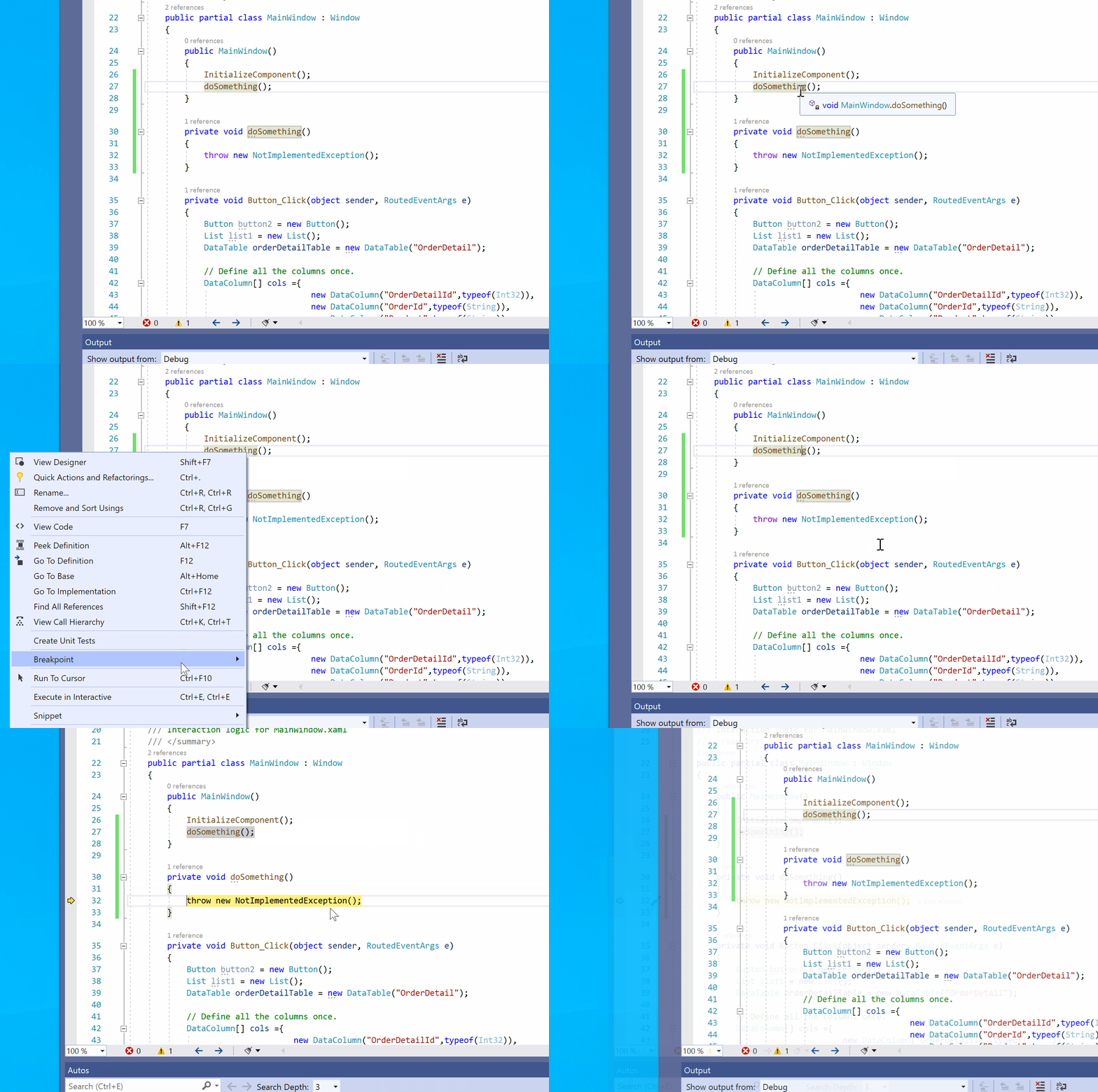
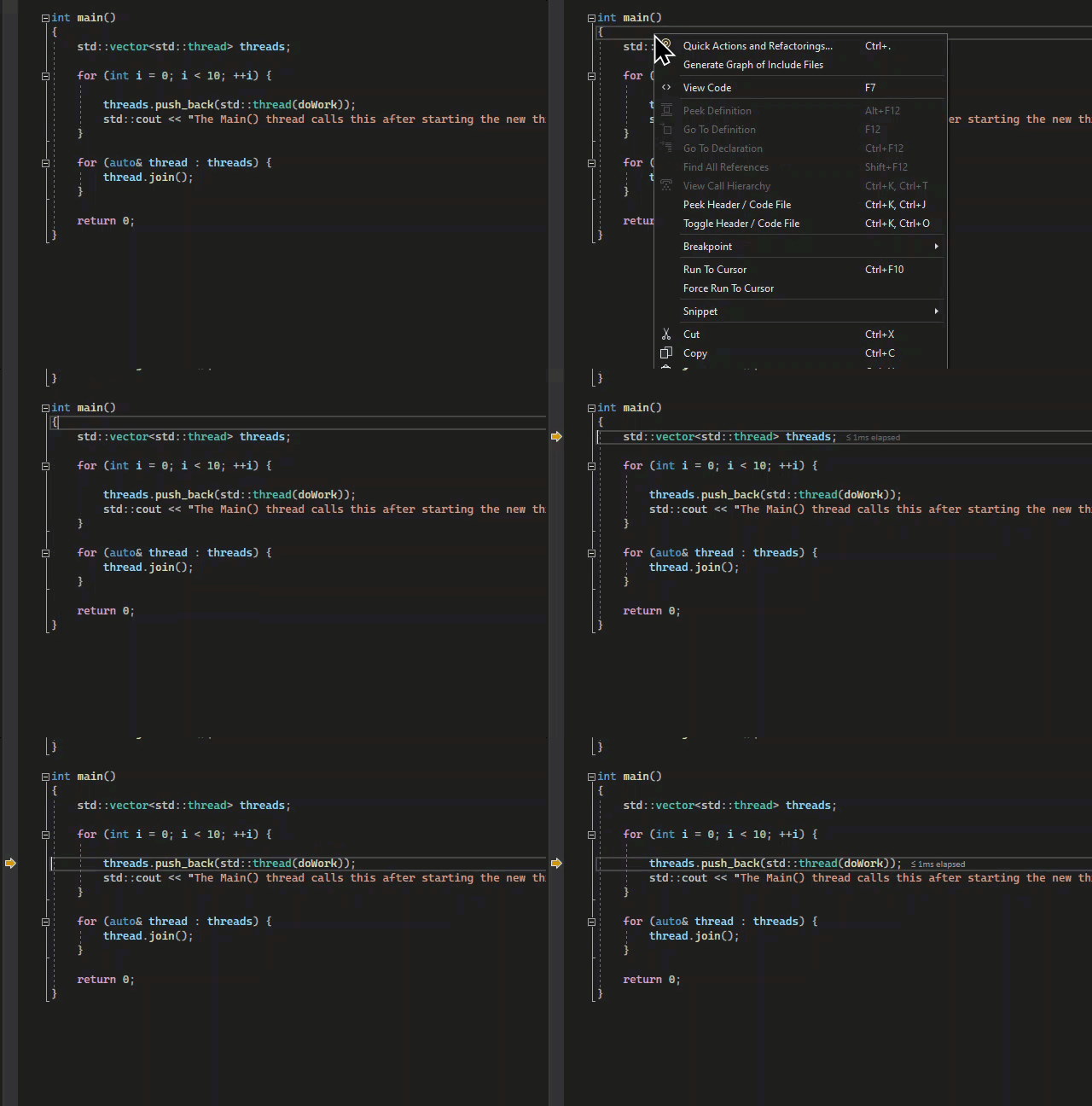
When you're in break mode, yous can utilise various commands to navigate through your lawmaking. Yous can examine the values of variables to wait for violations or bugs. For some project types, yous can also make adjustments to the app when you're in break style.
Most debugger windows, similar the Modules and Watch windows, are available only when the debugger is attached to your app. Some debugger features, like viewing variable values in the Locals window or evaluating expressions in the Sentry window, are available only when the debugger is paused (that is, in suspension mode).
Notation
If you break into code that doesn't take source or symbol (.pdb) files loaded, the debugger displays a Source Files Not Establish or Symbols Not Found page that tin help you notice and load the files. See Specify symbol (.pdb) and source files. If yous can't load the symbol or source files, you can all the same debug the assembly instructions in the Disassembly window.
Step through code
The debugger stride commands help you lot audit your app state or discover out more than about its execution flow.
Step into code line past line
To stop on each argument when you lot're debugging, utilise Debug > Footstep Into, or select F11.
The debugger steps through code statements, not physical lines. For instance, an if clause tin be written on one line:
int x = 42; string s = "Not answered"; if( int 10 == 42) s = "Answered!"; Dim ten As Integer = 42 Dim s As String = "Not answered" If 10 = 42 Then southward = "Answered!" But when y'all step into this line, the debugger treats the status as 1 pace and the consequence every bit some other. In the preceding example, the condition is true.
On a nested office call, Step Into steps into the nigh deeply nested function. For instance, if you apply Footstep Into on a call like Func1(Func2()), the debugger steps into the function Func2.
Step through code and skip some functions
You might not care near a function when you lot're debugging. Or might you know some code works, like well-tested library lawmaking. Yous can use the following commands to skip code when yous're code stepping. The functions yet run, but the debugger skips over them.
| Keyboard command | Debug carte control | Description |
|---|---|---|
| F10 | Step Over | If the current line contains a role call, Footstep Over runs the code so suspends execution at the first line of code after the called function returns. |
| Shift+F11 | Step Out | Step Out continues running code and suspends execution when the current part returns. The debugger skips through the current function. |
Run to a specific location or part
You might prefer to run directly to a specific location or role when you know exactly what code you want to inspect or if you know where you lot want to start debugging.
Run to a breakpoint in code
To set a unproblematic breakpoint in your lawmaking, select the far-left margin adjacent to the line of code where you want to suspend execution. Y'all can also select the line and then select F9, select Debug > Toggle Breakpoint, or correct-click and select Breakpoint > Insert Breakpoint. The breakpoint appears as a red dot in the left margin next to the line of lawmaking. The debugger suspends execution just before the line runs.


Breakpoints in Visual Studio provide a rich set of functionality, like conditional breakpoints and tracepoints. For details, encounter Using breakpoints.
Run to a part breakpoint
You tin can set the debugger to run until information technology reaches a specified role. Y'all can specify the part past name, or y'all tin can choose it from the call stack.
To specify a role breakpoint by name
-
Select Debug > New Breakpoint > Function Breakpoint.
-
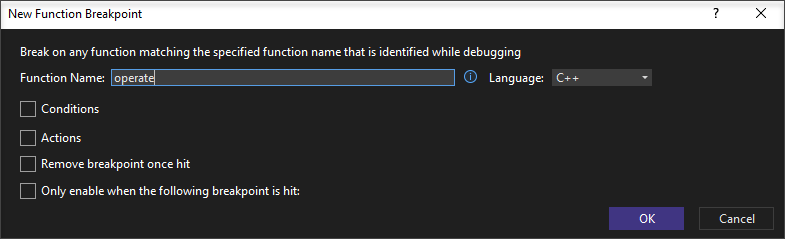
In the New Function Breakpoint dialog, enter the name of the function and select its language:

-
Select OK.
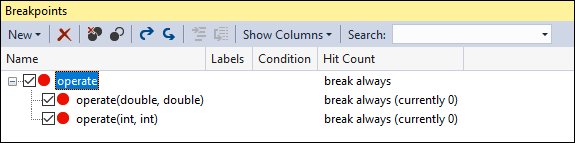
If the function is overloaded or in more than than one namespace, y'all can choose the one you lot want in the Breakpoints window:
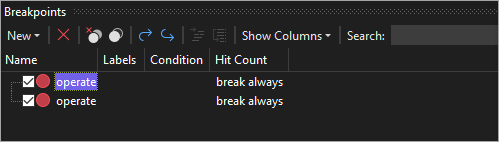
To select a function breakpoint from the call stack
-
While debugging, open the Telephone call Stack window by selecting Debug > Windows > Call Stack.
-
In the Call Stack window, right-click a function and select Run To Cursor, or select Ctrl+F10.
For data about visually tracing the call stack, see Map methods on the phone call stack while debugging.
Run to a cursor location
To run to the cursor location, in source lawmaking or the Call Stack window, select the line you desire to intermission at, and and so right-click and select Run To Cursor, or select Ctrl+F10. Selecting Run To Cursor is like setting a temporary breakpoint.
Force run to a cursor location
To run to the cursor location, in source code or the Call Stack window, select the line you want to break at, and and so correct-click and select Force Run To Cursor. Selecting Force Run To Cursor will skip any breakpoints and first-chance exceptions until the debugger reaches the line of code where the cursor is located.
Run to Click
While the debugger is paused, y'all can hover over a statement in source code or the Disassembly window and select the Run execution to here green arrow. If you use Run to Click, yous don't need to set a temporary breakpoint.

Annotation
Run to Click is bachelor starting in Visual Studio 2017.
Force Run to Click
While the debugger is paused, you can hover over a statement in source code while pressing the Shift key and then select Force run execution to here (the double light-green pointer). When you choose this option, the application attaches the Visual Studio debugger and pauses at the cursor location. Any breakpoints and first-take chances exceptions found during execution are temporarily disabled.
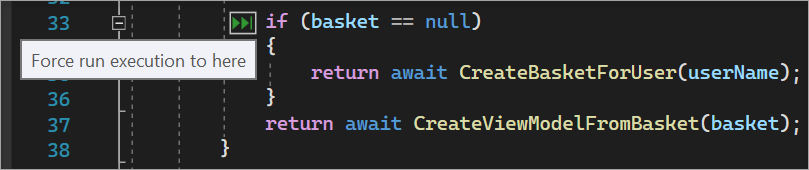
Note
Force Run to Click is available starting in Visual Studio 2022.
Manually break into code
To suspension into the adjacent available line of code in a running app, select Debug > Interruption All, or select Ctrl+Alt+Break.
Move the pointer to change the execution flow
When the debugger is paused, a yellow arrow in the margin of the source code or Disassembly window marks the location of the statement that volition run next. You tin can modify the next statement that will run past moving this arrow. Y'all tin skip over code or return to a previous line. Moving the pointer is useful for situations like skipping lawmaking that contains a known bug.


If you want to alter the side by side argument that will run, the debugger must be in intermission way. In the source code or Disassembly window, elevate the yellow arrow to a different line, or right-click the line y'all want to run next and select Fix Next Argument.
The program counter jumps directly to the new location. Instructions between the sometime and new execution points aren't run. But if you motion the execution point backwards, the intervening instructions aren't undone.
Caution
- Moving the side by side argument to another part or telescopic usually causes call-stack corruption, which causes a runtime error or exception. If yous try to move the next statement to another scope, the debugger gives y'all a alarm and a chance to cancel the operation.
- In Visual Bones, you lot can't movement the adjacent statement to another telescopic or office.
- In native C++, if you lot take runtime checks enabled, setting the next statement can cause an exception when execution reaches the end of the method.
- When Edit and Go along is enabled, Set up Next Statement fails if you've fabricated edits that Edit and Continue can't remap immediately. This state of affairs tin occur, for example, if you've edited code in a catch block. When this happens, an error message tells yous that the operation isn't supported.
- In managed code, yous can't move the next statement if:
- The adjacent statement is in a different method than the current statement.
- Debugging was started by Only-In-Time debugging.
- A call stack unwind is in progress.
- A Arrangement.StackOverflowException or Organisation.Threading.ThreadAbortException exception has been thrown.
Debug non-user code
By default, the debugger tries to debug just your app lawmaking by enabling a setting called Just My Code. For details virtually how this characteristic works for diverse project types and languages, and how you tin customize it, see Just My Code.
To expect at framework code, third-party library lawmaking, or organisation calls while debugging, y'all tin can disable Just My Code. In Tools (or Debug) > Options > Debugging, clear the Enable Just My Lawmaking checkbox. When Just My Code is disabled, not-user code appears in the debugger windows, and the debugger tin can stride into the not-user code.
Note
Just My Code isn't supported for device projects.
Debug system lawmaking
If you've loaded debugging symbols for Microsoft system code and disabled Simply My Lawmaking, you lot tin can step into a system phone call only as you can any other phone call.
To acquire about loading Microsoft symbols, see Configure location of symbol files and loading options.
To load symbols for a specific system component
-
While you lot're debugging, open up the Modules window past selecting Debug > Windows > Modules or past pressing Ctrl+Alt+U.
-
In the Modules window, you can tell which modules have symbols loaded in the Symbol Status cavalcade. Right-click the module that you want to load symbols for and then select Load Symbols.
Footstep into backdrop and operators in managed code
The debugger steps over properties and operators in managed lawmaking by default. In most cases, this behavior provides a better debugging feel. To disable stepping into properties or operators, select Debug > Options. On the Debugging > General page, clear the Step over backdrop and operators (Managed merely) checkbox.
Come across also
- What is debugging?
- Debugging techniques and tools
- Starting time look at debugging
Feedback
Submit and view feedback for
Source: https://docs.microsoft.com/en-us/visualstudio/debugger/navigating-through-code-with-the-debugger#:~:text=Run%20to%20a%20breakpoint%20in%20code&text=You%20can%20also%20select%20the,just%20before%20the%20line%20runs.

Post a Comment for "Continue to Break Point Again Visual Studio"