What Call a Woman Who Takes Care of 4 Years Baby
For working parents in the U.Southward., the challenge of juggling careers and family life continues to be a front-burner issue – 1 that is being recognized by a growing number of employers who take adopted family-friendly policies such every bit paid go out. But while few Americans desire to encounter a render to traditional roles of women at home and men in the workplace, one reality persists: Women virtually often are the ones who adapt their schedules and make compromises when the needs of children and other family members collide with work, Pew Research Center data testify.
In a 2013 survey, we found that mothers were much more than likely than fathers to report experiencing significant career interruptions in order to attend to their families' needs. Office of this is due to the fact that gender roles are lagging behind labor force trends. While women represent virtually half of the U.S. workforce, they withal devote more fourth dimension than men on average to housework and child care and fewer hours to paid work, although the gap has narrowed significantly over fourth dimension. Amongst working parents of children younger than eighteen, mothers in 2013 spent an boilerplate of 14.2 hours per week on housework, compared with fathers' 8.6 hours. And mothers spent ten.7 hours per week actively engaged in child care, compared with fathers' 7.2 hours.
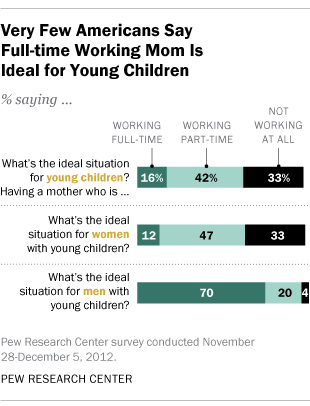
Another cistron is the style that club views the bail between mothers and their children. In a 2012 Pew Research survey, the vast bulk of Americans (79%) rejected the notion that women should return totheir traditional part in society. Nevertheless when they were asked what is best for young children, very few adults (16%) said that having a mother who works total time is the "ideal situation." Some 42% said that having a mother who works part fourth dimension is platonic and 33% said what'due south best for young children is to have a mother who doesn't piece of work at all. Even amidst full-time working moms, but nearly one-in-five (22%) said that having a full-time working mother is ideal for immature children.
When asked what's best for women themselves, the public expressed a similar sentiment. Just 12% of adults said the platonic situation for women with young children is to piece of work total time. About half (47%) said working part fourth dimension is ideal for these women, while 33% said not working at all would be the best situation.
The public applies a much different standard to fathers. When we asked about the ideal situation for men with immature children, fully 7-in-ten adults said working full time would be platonic for these fathers. 1-in-five adults said function-fourth dimension work would be ideal and only iv% said it would be best for these dads non to work at all.
In reality, the "ideal" situation is not always the nigh applied, nor is it always attainable. In fact, co-ordinate to U.Southward. regime data, 64% of mothers with children younger than half dozen are in the labor forcefulness, and amid working mothers, 72% work total time.
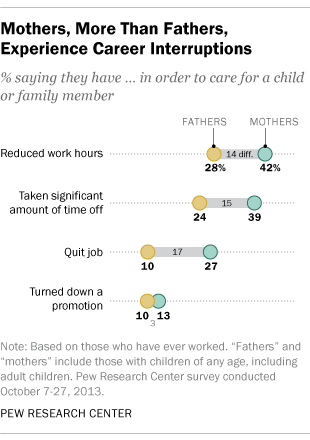 One effect is that while 42% of mothers with some work experience reported in 2013 that they had reduced their work hours in club to care for a child or other family member at some point in their career, only 28% of fathers said the same. Similarly, 39% of mothers said they had taken a significant amount of time off from work in order to care for a family fellow member (compared with 24% of men). And mothers were almost three times as likely as men to report that at some indicate they quit a task and so that they could care for a family member (27% of women vs. 10% of men).
It'due south important to note that when we asked people whether they regretted taking these steps, the resounding answer was "No." However, it'south as well of import to note that women who had experienced these interruptions were much more likely than men to say that this had a negative impact on their career. For example, women who took time off at some betoken in their piece of work life to care for a kid or other family unit member were twice equally likely as men who did the same to say that this injure their career overall (35% vs. 17%). Similarly, amongst those who took a meaning amount of time off from work to wait afterward a family member, 32% of women compared with 18% of men said doing this hurt them professionally.
According to many economists, family-related career interruptions tin can undermine women's economic prospects in a multifariousness of ways, by contributing to the gender wage gap and by narrowing the pipeline that feeds superlative-level jobs. Of course, for lots of women these interruptions may serve every bit the catalyst to a more counterbalanced life which may in plow outweigh any lost fiscal benefits.
In her new book "Unfinished Business organization: Women, Men, Work, Family," Anne-Marie Slaughter raises many of these issues, and in a recent New York Times article, Slaughter said that what is needed in guild to alter individual workplaces is a "culture modify: fundamental shifts in the way we recollect, talk and confer prestige." Our data suggest that a generational shift, if not a culture modify, may be coming. When nosotros asked young adults (ages 18 to 32) who don't yet have children whether they anticipate that condign a parent will make it harder or easier for them to advance in their job or career, immature men were only as likely as immature women to say that children volition likely slow down their career advocacy (roughly 60% in each group). This suggests that Millennial men may be entering their careers with a different set of expectations about what balancing family life and work will entail.
At the aforementioned time, though, among young adults with children, women are much more probable than men to say being a working parent makes information technology harder for them to get ahead at work (58% of Millennial moms say this, versus 19% of Millennial dads).
These issues heighten anew debates over government and workplace policies designed to back up parents and families. While the national conversation continues, working parents across America will go along to juggle their many responsibilities – making time for caregiving along the mode.

Kim Parker is director of social trends research at Pew Research Center.
Source: https://www.pewresearch.org/fact-tank/2015/10/01/women-more-than-men-adjust-their-careers-for-family-life/

Post a Comment for "What Call a Woman Who Takes Care of 4 Years Baby"